changing neighborhoods
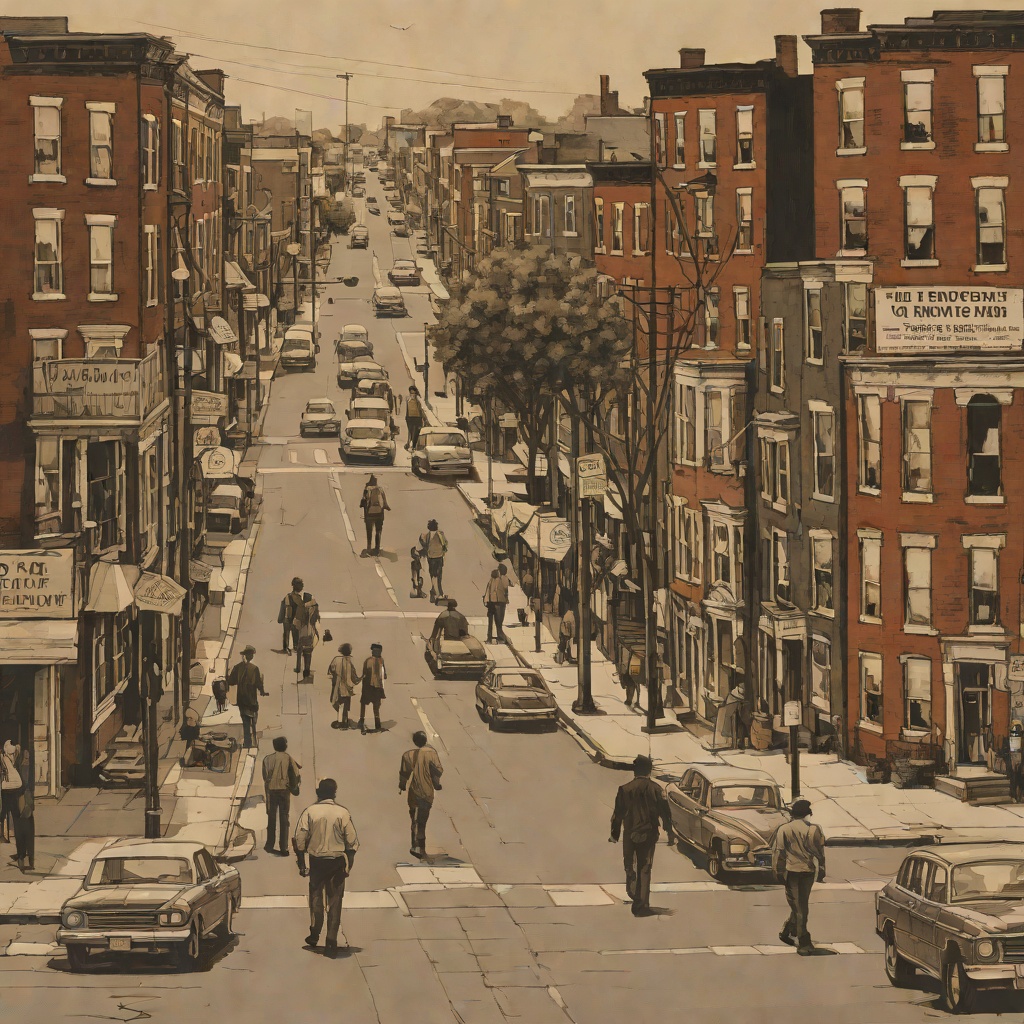
Lady in the LakeChanging neighborhoods is the novel's quiet, relentless engine of social transformation, a demographic process that reshapes Baltimore's northwest corridor during the 1960s and exposes the deep racial fault lines running through the city. The term describes the migration of white families out of areas as Black families moved in, a shift that the novel treats not as abstract sociology but as a lived, felt reality with concrete consequences for housing, schooling, business, and policing. It is the condition that determines where Maddie Schwartz can afford to live after separating from her husband, the reason the Fine family's synagogue community relocated, the opportunity that Ezekiel Taylor seizes for his dry-cleaning business, and the backdrop against which the city's segregated institutions—schools, police, newspapers—are revealed as stubbornly resistant to change. More than any single event, this ongoing transformation defines the social geography of the novel, separating characters into different worlds even when they occupy the same city blocks.
The Geography of White Flight and Black Arrival
The novel charts the changing neighborhoods with precise, telling detail. Maddie's post-separation apartment on Gist Avenue, while on the right side of Northern Parkway, turns out to be in a neighborhood that is decidedly mixed—"mixed on its way to being not so mixed," as she observes. The landlord had deliberately scheduled her afternoon viewing when the streets were empty and quiet, a tactic that allowed her to see only the apartment's charm—the warm winter sunlight creating golden squares on empty wood floors, the tiny pink-and-blue tiles in the bath—rather than the demographic reality of her new surroundings. It is only when she begins moving her things in that she grasps the truth: she is a solitary white woman in a neighborhood of maids and laundresses, milkmen and streetcar conductors, and her neighbors snub her as if she were the undesirable one. The signs of transition are legible to those who know how to read them: the "Under Contract" and "SOLD" signs swinging beneath the original "For Sale" signs are covert code for "Get out now." Maddie understands the mass hysteria that causes property values to plummet rapidly, even as she cannot understand why whites in the city don't want to live next to Black people. The novel notes the irony that Christian neighborhoods hadn't wanted the Jews either—and still didn't, really—suggesting that the changing neighborhoods are merely the latest iteration of a long American pattern of exclusion and flight.
The Migration of Institutions and Communities
The changing neighborhoods also reshape the city's institutional geography. The Park School, where Maddie's mother Tattie Morgenstern and Tessie Fine's grandmother had been classmates, was originally on Auchentoroly Terrace, the preferred school for German Jewish families whose children had not been welcome at the city's older private schools. As the neighborhood around Druid Hill Park "changed"—the preferred euphemism for integration—the families and the school migrated to the northwest, first to Liberty Heights, where Maddie attended, and then to Brooklandville, almost all the way to the Beltway, where Maddie's son Seth became a third-generation student. The Fine family's own trajectory reflects this pattern in reverse: Tessie's father, Bobby Fine, chose to live within the eruv in Park Heights, a more conservative, more Orthodox choice than his parents had made, and his mother blamed his wife for this unseemly embrace of religious stringency. The changing neighborhoods thus operate on multiple registers simultaneously—as a story of racial transition, as a story of Jewish upward mobility and internal division, and as a story of how institutions carry their histories with them even as they relocate.
Race, Policing, and the Limits of Integration
The changing neighborhoods intersect most painfully with the city's segregated institutions. Ferdie Platt, the Black police officer who becomes Maddie's lover, explains the reality of the department: it is segregated, Negro cops walk patrols or do undercover narcotics work, they can't use cars, and Ferdie doesn't even have a radio, just a call-box key. The department's structure mirrors the city's residential patterns—separate and unequal, with Black officers confined to certain roles just as Black families are confined to certain neighborhoods. When Maddie is outraged that the men at the Star dismissed Cleo Sherwood's disappearance, Ferdie laughs at her and tells her plainly: "Because she's a Negro, Maddie. That's why it wasn't a big deal when she went missing." The changing neighborhoods have not changed the fundamental calculus of who matters and who doesn't. Even Maddie's own lover, a man she believes she loves, cannot escape this logic: when she asks why he wouldn't attend a funeral, he answers simply, "She's colored." The neighborhoods may be changing, but the racial hierarchy that structures them remains stubbornly in place.
Ezekiel Taylor and the Economics of Transition
For Ezekiel Taylor, the changing neighborhoods represent opportunity rather than threat. Maddie visits the newest location of EZ Kleeners, which sits next to a beauty shop in a neighborhood just beginning to change. The location is strategic: the white women walking into Pietro's to get their hair cut and styled would be happy for the convenience of a dry cleaners in the neighborhood, but they wouldn't want Mr. Taylor as their neighbor. Taylor himself has the charisma of a successful man, bulky, moving slowly and speaking softly, but with sharp, watchful eyes that assess Maddie quickly as she approaches with her reporter's pad. His business thrives precisely because of the demographic transition that makes other whites flee. Yet the changing neighborhoods do not grant Taylor real power in the city's political life. In the 1966 primary, he finishes a distant fourth in the race for the Fourth District senate seat, his campaign underwritten by Shell Gordon's dirty money. The neighborhoods may be changing, but the levers of power remain firmly in white hands.
The Persistence of Division
The novel ultimately uses the changing neighborhoods to expose the limits of integration as a solution to racial division. Maddie, reflecting on the Sherwood case, sees the world for what it is: men are entitled to have their girls on the side as long as they are discreet, and some men feel entitled to kill the women who do not return their affections. Cleo Sherwood did not matter enough to sway an election; she had never mattered at all. The changing neighborhoods had not changed this calculus. Even Maddie's own life, decades later, is shaped by the same divisions: she is a grandmother now, still attractive, and her relationships remain compartmentalized—a forty-year-old gardener who comes to her apartment and leaves, a pompous old judge who needs a presentable companion. The novel's final irony is that the neighborhoods changed, but the people in them did not. The physical geography of Baltimore shifted, but the social geography of race and class, of who belongs where and with whom, proved far more durable. The changing neighborhoods are thus not a story of progress but a story of rearrangement, a reshuffling of the same cards that leaves the underlying hierarchy intact.